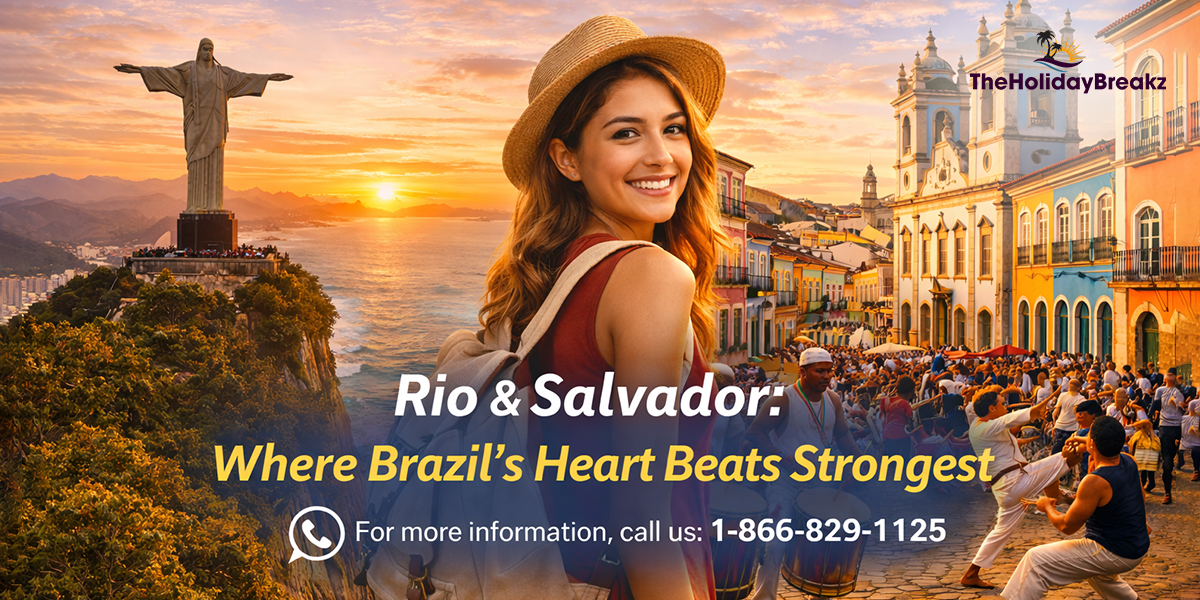
Rio & Salvador: Where Brazil’s Heart Beats Strongest
Brazil is not a destination you simply visit it’s a place you feel deeply, long after your journey ends. Among its many remarkable cities, Rio de Janeiro and Salvador stand apart not in competition, but in contrast. Together, they reveal Brazil’s emotional range: joy and struggle, rhythm and reflection, spectacle and soul. This Rio and Salvador travel guide explores why experiencing both cities offers a richer, more meaningful understanding of the country.
Rio de Janeiro: Energy Written Into the Landscape
Few cities in the world match Rio’s dramatic setting. Mountains plunge into the Atlantic Ocean, while golden beaches stretch beneath a skyline crowned by Christ the Redeemer. But beyond the postcard views lies a city driven by emotion, movement, and confidence.
Daily life in Rio unfolds outdoors. Locals jog along the shore at sunrise, musicians practice in open squares, and conversations spill out of cafés late into the night. Football, music and celebration are not pastimes here they are shared languages that connect people across neighborhoods and backgrounds.
The Rio de Janeiro travel experience is defined by contrast. One moment you’re soaking in the calm of a beach afternoon the next, you’re swept into the intensity of a samba rehearsal echoing through the streets. Even away from major events like Carnival the city carries an undercurrent of anticipation as if something joyful is always about to happen.
Beyond the Surface: Rio’s Cultural Layers
While Rio’s beauty is immediate, its cultural depth reveals itself slowly. Neighborhoods such as Santa Teresa and Lapa showcase the city’s artistic spirit, where colonial architecture, street art and live music coexist effortlessly. These areas remind visitors that Rio’s identity isn’t only about beaches and festivals it’s also about creativity, resilience, and community expression.
The city’s openness is one of its greatest strengths. Strangers become friends easily, conversations start naturally and moments feel shared rather than observed. This openness gives Rio its unmistakable character bold, expressive and unapologetically alive.
Salvador: Where History Speaks Through Rhythm
If Rio is Brazil’s pulse, Salvador is its memory. Founded in the 16th century, Salvador was the country’s first capital and the gateway through which African traditions entered Brazil. Today, that heritage defines the city’s character.
Walking through Salvador’s historic center feels like stepping into a living archive. Colorful buildings line cobblestone streets, while church bells, drumbeats and everyday conversation create a soundtrack rooted in centuries of tradition. The city doesn’t attempt to separate past from present they exist together, shaping daily life.
Understanding Salvador Brazil culture means recognizing how African, Indigenous, and European influences have blended into something entirely unique. This fusion is visible in religious practices, music, dance and food all of which are treated with reverence rather than nostalgia.
Spirituality, Music, and Identity
Salvador’s soul is deeply spiritual, though not confined to formal religion. Traditions such as Candomblé reflect a worldview where nature, ancestry and community are interconnected. Music plays a similar role acting as both expression and preservation of identity.
Drumming traditions, capoeira circles, and street performances aren’t staged attractions they are extensions of everyday life. This authenticity is what draws travelers seeking more than surface-level sightseeing. Salvador invites visitors to listen, observe and feel rather than rush.
A Tale of Two Cities
Travelers often debate whether to choose Rio or Salvador, but the truth is that the two cities complete each other. Rio shows Brazil’s outward confidence its ability to celebrate life loudly and without hesitation. Salvador reveals Brazil’s inner strength, grounded in history and cultural continuity.
Together, they represent two of the best cities to visit in Brazil each offering a different emotional entry point into the country. One dazzles through scenery and movement; the other captivates through meaning and memory.
Why Culture Matters in Brazilian Travel
Brazil’s identity cannot be separated from its cultural roots. Music, dance, faith, and food are not entertainment alone they are tools of storytelling. Experiencing both cities allows travelers to understand Brazil as more than a tropical escape.
These cities stand as defining Brazil cultural destinations not because they preserve culture behind museum walls, but because culture actively shapes daily life. From Rio’s spontaneous celebrations to Salvador’s ancestral rituals, tradition remains alive and evolving.
Travel That Leaves a Mark
The true value of visiting Rio and Salvador lies in what stays with you afterward. It’s the memory of shared laughter with strangers the echo of drums at dusk, the realization that joy and history can coexist beautifully.
Traveling between these cities isn’t just a change of scenery it’s a shift in perspective. You begin to see Brazil not as a single story but as a layered narrative shaped by geography, heritage and human connection.
Final Reflection
Experiencing Rio de Janeiro and Salvador Brazil together offers a fuller, more honest picture of the country. One city teaches you how Brazilians celebrate life the other teaches you why that celebration matters.
When you leave, you won’t just remember places you’ll remember feelings. And that’s when you know Brazil has truly reached you.